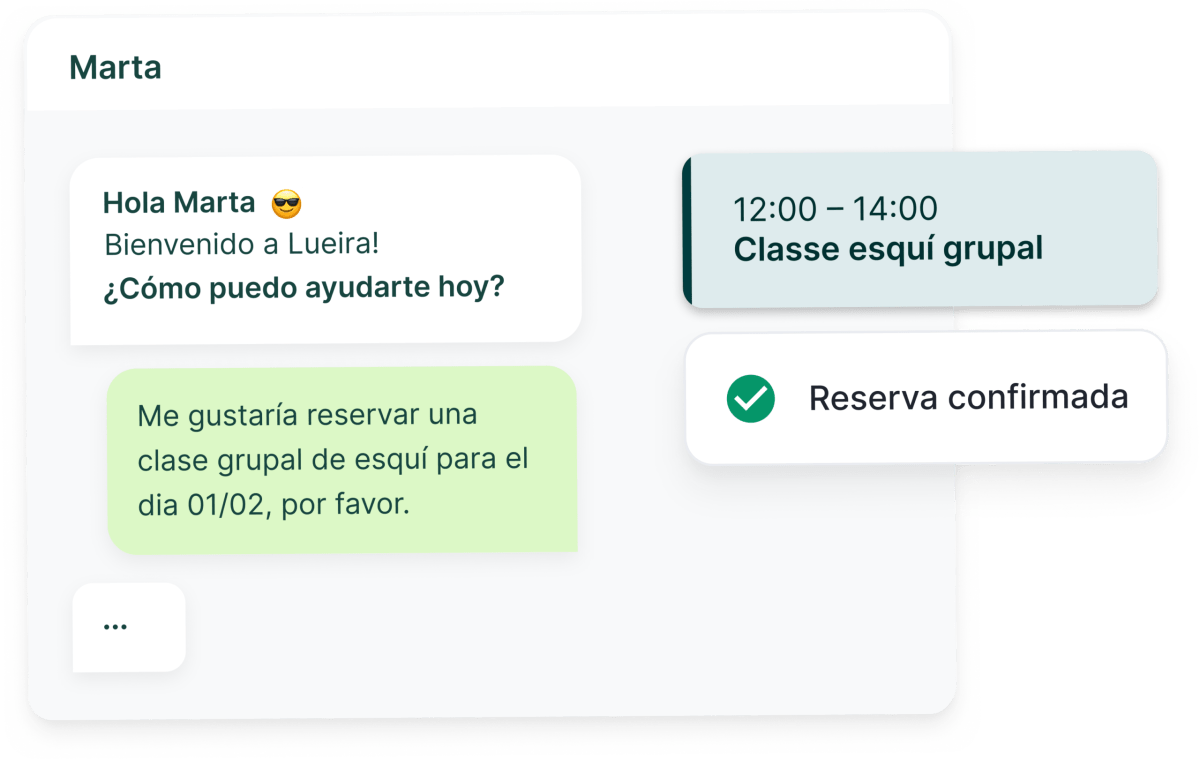
In March 2023 we described Lueira in one sentence: bookings, staff and stock in one place for mountain sports schools. A year later, we shipped a feature that changes what "one place" means for the person actually talking to a customer: an AI agent that lives inside WhatsApp, answers questions automatically, checks real-time availability, manages bookings, and sends payment links, without anyone leaving the conversation. We could have built a customer-facing app instead — a dashboard, a booking widget, the kind of feature most booking software eventually ships. We didn't, and the reasoning behind that is worth writing down while it's still fresh.
1. Where mountain sports schools actually live
When we wrote about why we built Lueira, the pattern that stood out from talking to ski schools, surf schools, rental shops and dive centers was that nobody ran their business through one system. Instructors got their schedule from a WhatsApp group. Bookings came in by phone or Instagram DM and landed in a shared spreadsheet. And when we looked closer at how customers actually reached these schools, the same channel kept showing up: WhatsApp. Not the school's website, not a booking form, not an app — a chat, usually the same one where a customer had already asked a friend for a recommendation or messaged the instructor directly last season.
That's not a habit we could design around; it's the actual behavior we had to build for. A parent booking a ski lesson for their kid, a group of friends asking about tomorrow's surf conditions, someone changing a reservation an hour before pickup — all of that already happened in WhatsApp, faster and with less friction than any form could offer. Building yet another app that customers would have to download, and that schools would then have to convince people to actually use, meant fighting against behavior that already worked. Meeting people where they already were wasn't a technical shortcut. It was the actual product decision.
2. What you give up when you choose a conversation over an app
Choosing WhatsApp as the interface has a real cost, and it's worth being honest about it rather than pretending a chat window is strictly better than a dedicated app. You give up a lot of what a custom interface gives you for free: no calendar widget with color-coded availability, no drag-and-drop to move a booking, no filters, no visual comparison between two lesson packages side by side. A chat is a single, linear thread. Anything you'd normally show with layout, you now have to say.
In exchange, you get zero onboarding friction. There's no account to create, no app to install, no interface to learn — the customer is already inside WhatsApp, and the agent meets them exactly there. But that trade only pays off if the conversation can actually do things, not just talk about them. Designing a chat that feels natural and still reliably checks real-time availability, holds a slot, and sends a working payment link is a different design problem than a nice UI. A dashboard fails visibly — a broken button just sits there, broken. A conversation that gives a wrong answer sounds exactly as confident as one that gives a right one, and the customer has no way to tell the difference until the booking doesn't show up.
3. Raising the stakes of 24/7
Lueira's agent answers 24/7, which is also the whole pitch: automate the communication a school used to have to staff manually. But 24/7 raises the stakes in a way that's easy to underestimate on a slide and much harder to live with in practice. If a school owner doesn't answer a WhatsApp message at 11pm, a customer waits until morning and nobody thinks much of it — a human being unavailable outside working hours is normal. If an AI agent representing the school answers instantly, at any hour, and gets the availability wrong, or promises a slot that isn't actually there, that failure is harder to excuse. The bar for correctness goes up exactly because the bar for showing up goes up.
That's why this launch is deliberately narrower than "an AI that chats about anything." The agent is connected to real-time availability and to the school's actual operations, not to a general sense of what a booking usually looks like — because being always on only pays off if being always on doesn't mean being sometimes wrong.
4. What's next
This post is about the product decision, not the plumbing. How the agent is actually built — the tool calls it makes into Lueira's booking engine, how we keep it honest about availability, what happens when it doesn't know an answer — is a separate story, and a more technical one, that we'll tell in a follow-up post: Teaching an AI agent to actually book things. For now, the short version is this: mountain sports schools' customers were never going to move to us. We had to go to them, on the channel they were already using, and make sure that once we were there, the agent could actually do the job, not just talk about it.
A year after founding Lueira, this is still the same bet from the first post: build for how these schools and their customers actually work, not for how a generic SaaS assumes they should. WhatsApp isn't a shortcut we took because it was easy to build. It was, once we looked honestly at where the conversations already were, the only channel that made sense to build for first.