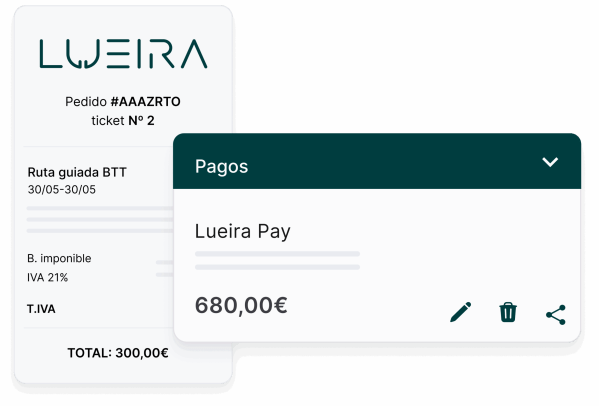
Every feature we build for Lueira starts with a simple question: who is this for? Usually it's the person behind the counter — the ski instructor checking in a group booking, the dive shop owner closing out the till on a Saturday. But the financial management module we shipped this year is different. On paper it looks like the usual stuff: manage tickets and invoices instantly, keep an eye on income and expenses. But buried in that description is a phrase that isn't really about the business owner at all — "cumplimiento de la facturación electrónica," compliance with electronic invoicing. That phrase exists because of the tax authority, not the customer, and it's worth explaining why a small mountain sports school now has to care about it, and why we decided it belonged inside a booking platform rather than as a separate problem for our customers to solve on their own.
1. A new legal requirement nobody in a ski school signed up for
Spain has been steadily tightening the rules around how businesses and self-employed people issue invoices, as part of a broader anti-fraud push. The piece of this that matters most for small operators is usually referred to informally as "Verifactu": invoicing software has to produce records that are verifiable and tamper-evident, with each invoice cryptographically linked to the one before it, so nobody can quietly delete or backdate a record after the fact — and depending on the option chosen, that record can also be reported to the tax agency (AEAT) close to the moment it's issued.
I want to be careful here about specifics, because the exact deadlines and thresholds have shifted more than once as the rules have been refined, and I'd rather point you to the official source than assert a date that might no longer be accurate by the time you read this. What I am confident about is the direction: invoicing that used to be entirely up to the business — a spreadsheet, a Word template, sometimes literally a notebook — is being formalized, and the software used to produce it now carries obligations of its own.
That's the part that catches small businesses off guard. A one-person ski school owner is good at teaching people to ski. They are not, and have no interest in becoming, an expert in cryptographic record chaining or tax-agency reporting formats. Yet under the new framework, if the invoicing software they use doesn't meet the requirements, the liability doesn't stay neatly with the software vendor — it lands on the business issuing the invoice.
2. Why "add a PDF export" isn't the answer
When we scoped this feature, the instinct from outside would be: just add a button that generates a PDF invoice from a booking. That's roughly what a lot of booking software does today, and it's not what compliance actually requires.
First, the data on the invoice has to be correct and complete at the moment it's generated, not fixed up later. That means the business's tax ID, the customer's details when required, and the applicable VAT/IVA rate for that specific product or service all have to be resolved correctly before the invoice is created. A ski lesson and a piece of rental equipment can carry different tax treatment, and getting that wrong isn't a cosmetic bug — it's an incorrect legal document.
Second, invoice numbering has to be sequential and unbroken within its legal series. You can't delete invoice #47 because someone made a booking error and just skip the number — the series has to stay intact, which means the error gets corrected through a proper credit note or rectification, not erased.
Third, and this is the one that's easy to underestimate: the record has to remain tamper-evident going forward. Each invoice is chained to the previous one, so a change anywhere in the sequence is detectable. That's not a property you can bolt onto a PDF exporter after the fact — it has to be designed into how invoices are stored and generated from day one.
And finally, the obligation doesn't stop at "the business must comply" — the software itself has requirements to meet. That changes what "add invoicing" means for us as a vendor: it's not a feature request, it's a compliance commitment we're making on behalf of every school and shop using Lueira.
3. Compliance as a byproduct, not a chore
The reason this was worth building properly, rather than pointing customers to a separate invoicing tool, is that Lueira already has the one thing compliant invoicing actually needs: complete, accurate data about the transaction at the moment it happens. A booking already knows the product, the price, the applicable tax treatment, and the customer. Turning that into a correctly numbered, tamper-evident invoice isn't a new manual step for the owner — it happens automatically as the natural conclusion of a sale that was already going to take place inside the platform.
That's the difference I care about here. For a one-person operation, the realistic alternative to "the booking platform handles this" is either paying an accountant to re-key every transaction into separate invoicing software, or muddling through with tools that were never built for this and hoping nothing goes wrong. Neither is a good use of a ski instructor's or a dive guide's time, or their legal exposure. If a vertical piece of software already sits at the center of how a business takes bookings and payments, it's in a better position than almost anyone else to absorb this kind of regulatory complexity quietly, correctly, and without turning it into a chore the owner has to think about every day.
None of this makes for an exciting feature announcement — nobody asks for a demo of invoice numbering integrity. But it's exactly the kind of unglamorous work that decides whether small business software is actually useful or just adds one more thing to worry about. If the law keeps moving in this direction, and it looks like it will, the businesses best served will be the ones whose everyday tools already did the hard part for them.